Loksewa Computer Engineer and IT Officer in Nepal
Government IT and Computer Engineering jobs in Nepal have become increasingly competitive due to job security, structured career progression, fixed working hours, and stable salary benefits. This guide covers:
- Salary details
- Qualification requirements
- Syllabus overview
- Study strategy
- Vacancy tracking
- Best preparation resources
- Reality of government IT careers in Nepal
Motivation
Everything starts with a motivation. Why go for government services?
-
Out of altruism.
-
Secured job, fair+meritocratic selection and fair+dependable+predictable salary.
-
Fixed working hours.
-
Side benefits like loans, insurance etc depending on the corporation you are working for.
-
Inclusive representation for socially, economically and historically marginalized communities.
No job is good or bad. You need to weigh pros and cons of the type of jobs based on your position in life and career.
Salary details
The salary constitutes basic salary+various allowances+non-available stuffs like insurance etc. Salaries are in per month basis. The present list do not consider bonuses. Banks and other corporations in profit share bonuses upto 6 months to employees.
Note that these salaries will increase by 21% after the budget for FY 2083/84. I have not updated the salaries based on that.
-
Nepal Rastra Bank=1,33,347
-
SEBON=90,895
-
Nepal Insurance Authority=92,742
-
Nepal Electricity Authority=77,075
-
Nepal Telecom Company Ltd=88,300 (they also provide bonuses upto six months salary. It is not included in this calculation).
-
Vidhyut Utpadan Company Ltd=87,513
-
ADBL=68,469
-
RBBL=81,508
-
Citizen investment trust=79,732
-
Hydroelectricity Development and Investment Company Ltd=74,080
-
Nepal bank ltd=73,265
-
CDSC=68,817
-
Gorkhapatra Corporation=89,151
-
Nepal Nagarik Uddyan Pradikaran=83,906
-
Sadak Board Nepal=89,900
-
Nepal Paryatan Board=89,359
-
Employee Provident Fund=1,24,890
-
Social Security Fund=72,815
The salaries and benefits for sixth level officer is provided below:
De-motivation
Why not go for government jobs?
-
Deployed Location shifts constantly. Harder to meet with family. This might not be true for IT specific roles in some corporations. Generally, IT/Computer departments only run from the head office.
-
Lack of exponential career and financial growth.
-
Job locked in: It is usually cumbersome to resign immediately from government jobs.
-
Lack of creative and innovative work.
-
Lower salary relatively for higher positions compared to private companies(highly debatable though as it is not necessarily true for most folks).
Who am I?
I have worked in private technology sector jobs. I have been preparing for government computer engineer job since the past nine months.
Vacancy
Missing vacancy notices is very common in Nepal.
First seek the Loksewa’s yearly calendar. The yearly calendar for current loksewa cycle (2083/84) will be published in Ashad end. It contains expected vacancy, exam, interview dates.
To check vacancies opened at public corporations
To check vacancies at sangh/nijamati
The better solution is to automate this using changedetection software.
https://berojgarengineer.com/blog/monitor-loksewa-vacancies/
Read the blog above for how to achieve real time loksewa monitoring.
Job titles
Officer level positions’ title that are open in these companies:
-
Information Technology officer
-
Computer officer
-
Computer Engineer
-
Assistant Director(IT)
-
Assistant Director(Cyber Security)
-
Database Administrator
-
System Administrator
In some companies like Nepal Oil Corporation, you might also find a 5th level position generally called as “Head IT Assistant” instead of Officer level positions.
Qualifications required
The qualifications required varies. But in general a Computer Engineering Bachelors’ degree suffices for most of the officer level positions. Banks except Nepal Rastra Bank ask for master’s degree in IT or Engineering for officer level positions. For most non Engineer (i.e. Officer/DBA etc.), all IT streams can apply including BCA, BIT and Bsc.CSIT.
PS you do not need engineering license or bachelors degree for 4th level computer operator related roles. Government is planning to cut down Computer Operator roles. They probably want to train every government employees to be able to do basic IT tasks.
Computer Operator positions are equally lucrative in specific corporations like Nepal Rastra Bank, other government banks and financial institutions.
Syllabus
Syllabus for computer engineer and IT officer Loksewa positions at various corporations and nijamati are available in their respective websites. The syllabus is subject to change. But do not worry. It will not vary that much.
Thus, I highly recommend that you check syllabus updates time to time.
Note: Each corporations will take their exam differently. There is no single exam as of now. Hence the syllabus varies per corporation.
Common subjects:
- Computer Architecture / Computer Organization
- Operating System
- Computer Networks
- Data Structures & Algorithms
- Database Management System (DBMS)
- Software Engineering
- Programming (C / C++ / OOP / Java)
- Digital Logic / Digital Systems
- Microprocessor / Microcontroller / 8085 / 8086
- Cryptography & Network Security
- Emerging Technologies (AI, Big Data, Cloud, IoT)
- Management / Organization / Planning basics
- Numerical & Logical Reasoning (IQ tests for MCQ section)
Sporadic subjects:
These appear fewer in between but are of higher priority.
- Distributed Systems
- Advanced DBMS (Replication, Indexing, Query Optimization)
- Project Management (PERT, CPM, Monitoring)
- VHDL, Embedded Systems, PID Controller
- Theory of Computation (TOC: DFA, PDA, TM, NP)
- Compiler Design
- Computer Graphics
- Electrical / Electronics Fundamentals
previous year questions
The previous year question papers can be found in the link provided below:
https://berojgarengineer.com/blog/pyq-loksewa/
Exam Pattern
Most technical officer exams contain written exam and interview.
Written exam is usually two papers. First paper is based on GK+IQ+Organizational Knowledge. Second paper is based on technical subjects.
The exact structure varies by corporation.
How to study
As you can see from the previous year questions, the questions being asked in Loksewa Computer Engineering, IT officer exams are different from what we used to get on our Bachelors of Engineering degree. They are conceptual and broad.
But here is the catch which I hope you have recognized already.
There are too many subjects with too many contents in the Loksewa computer engineering, IT officer curriculum. The seats are limited. In most companies, the seats are limited to only one. So you are competing with many people for scarce resources.
To add, engineering concepts stack one upon another. So you have to study everything that follows a concept to certain level of understanding before trying to cram the important stuffs.
There are very few available question papers so you cannot extrapolate accurately.
How long should I prepare Loksewa Computer Engineer/IT Officer to crack it? The timeline can vary per individual basis. If you have solid foundations from Bachelors’, it might not even take 2 months to fully prepare all subjects. If your foundations are not very strong, it will take you lot of time. But 6 months to 1 year of full time study is enough to be prepared to crack for most people.
Preparation providing institutes
There are only three institutes providing classes for Loksewa computer engineer and IT officer.
- Line Academy
- iGlobe Academy
- APEX Academy
Notes
I urge you do not depend on a single non-standard resource like notes of someone else to learn. Follow the reference textbooks, university slides etc. Think of notes as just one more resource for researching about topics.
Good notes do help a lot however by saving time and headache.
Best books
The best books are as I said earlier, the standard textbooks. The topics are in the syllabi. And the possible questions and patterns are present in PYQs. if you still need some help, get any books that are available for Computer Engineer/IT Officer technical paper in Bhotahity bookshops.
There are no good books for technical paper.
best books for first paper
I have researched a lot on this. I have bought many GK books, IQ books, and first paper books of NTC. So, far the only book that I liked is GK King by Ashman Upadhayay.
The book’s link is given below:
GK King(for structured GK study):
https://s.daraz.com.np/s.ZPjHZ?cc
GK Saurav(For old questions solved):
https://s.daraz.com.np/s.ZPjry?cc
If you can get any one of them, get the latter one. It rocks for real. It contains all old questions till 2083 baisakh of GK organized in an easy to digest form. It is organized syllabus unit wise.
job+Loksewa
Many students start preparing for Loksewa along with a low paying job. It takes around 6 months to 1 year of full-time studies to complete the entire syllabus given rudimentary only knowledge. Most IT companies provide two days leaves. If you think you can manage that, go ahead. I feel that it is not manageable for many reasons. But I also started preparing along with a job. So you can start like that as well.
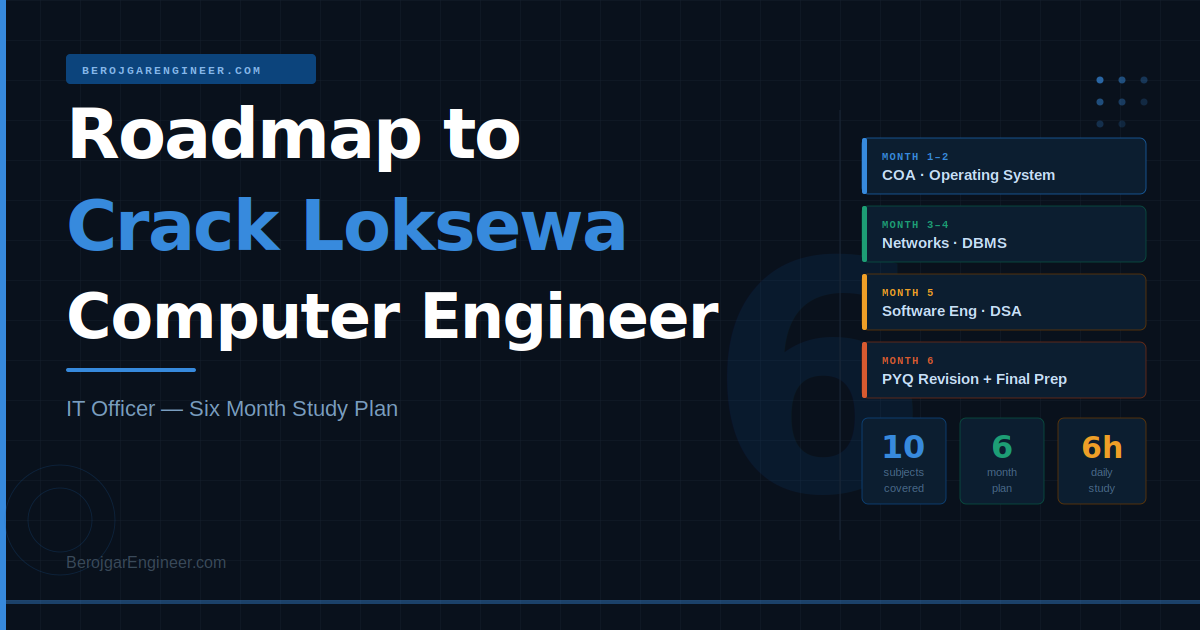
If you have read this and are looking for actionable roadmap on cracking Loksewa Computer Engineer or IT officer in the next six months, I think you will like to read the blog below: