Roadmap to crack Loksewa Computer Engineer and IT officer in six months
The idea for this post came around when a reader DM’d me regarding how to prepare for Loksewa in 3-6 months.
I had to be honest. 3 months of preparation is not enough for most average people. That might set the wrong impression that you can crack Loksewa exams with 3 months of preparation. I am not saying people have not cracked by studying properly within that time frame. I have personally seen lots of talented people who have cracked Loksewa Computer Engineer examinations within that time frame.
If you are fully directed, fully motivated,100% efficient, then 6 months of full-time study can be sufficient.
The biggest problem that aspirants face is “which corporation syllabus should I prepare first?”. This is a big confusion because Loksewa vacancies in a specific field are unpredictable. The exams occur within around 3 months of vacancy publication. And 3 months is not enough time for studying the entire corporation curricula.
But do not worry.
It is true that the Loksewa computer engineer syllabus is very vast and differs corporation-wise. But there is a pattern. There are some common subjects in every corporation.
The Loksewa computer engineer/IT officer exam contains two papers(except in NRB, which is 3 papers).
The first paper could be about GK, IQ, corporation-specific knowledge, and management knowledge. Do not worry about the first paper currently.
Firstly, focus on the second paper, i.e., the technical part.
Do not get me wrong, though. The first paper is easier to score due to predominantly multiple-choice questions. And it is what differentiates people who crack vs people who do not crack the Loksewa exam.
But since you will be just starting out, focus on the technical part first. After six months, start focusing on the first paper. For example: you study the technical part for six months. Complete it properly. Now a vacancy opens. Now what you have to do is study the first paper topics of that syllabus. It will not take more than one month to study the first paper if you do it full time.
The Common subjects in the technical part include:
- Computer Architecture / Computer Organization
- Operating System
- Computer Networks
- Data Structures & Algorithms
- Database Management System (DBMS)
- Software Engineering
- Programming (C / C++ / OOP / Java)
- Digital Logic / Digital Systems
- Cryptography & Network Security
- Emerging Technologies (AI, Big Data, Cloud, IoT)
There are 10 common technical subjects. You want to be prepared within 6 months. So you have to finish 3 subjects every 2 months. Note that these are just common subjects.
While in month 2, if a vacancy for some corporations appears, then you can obviously follow their syllabi. You do not have to force yourself to study topics that are not in that corporation’s syllabus.
In this case, I will assume no vacancies appear for the next 6 months.
How to study?
First things first.
Loksewa computer engineering and IT officer exams test on breadth of knowledge. In B.E or BSc.CSIT, you might have faced lots of numerical questions. Do not expect such numerical questions in the Loksewa Computer Engineer and IT Officer exam.
The hardest part of the following Loksewa-provided syllabus for Computer Engineer and IT Officer is that the micro-level syllabus is not clear based on the provided syllabus in many corporations. That causes genuine frustration. I wasted a lot of time going too deep because of this reason.
This is a huge problem. What do you study when the syllabus simply says Cryptography(case in point, RBB Sr. IT Assistant 5th level syllabus)? It is just teasing you.
How to get the micro-syllabus of each subject?
-
get a loksewa IT officer textbooks from bhotahity. Note that those books usually do not contain past question papers of loksewa computer engineer and IT officer. Most of the times, they are just copy-paste from Claude and Chatgpt. Specially if they are published few weeks after the vacancy is announced. cost=1500 onwards. And there is no surity that it will be worth the money.
-
join an institute for preparation because institute will provide notes and you can deduce the micro-syllabus based on the institute’s notes. cost=10,000 onwards. This option is too costly. While it is a good option, not everyone is in a position(not just financially) to spend 10,000 and onwards in an institute. And even institutes do not have entire collection of loksewa computer engineer and IT officer previous year question papers. I also joined an institute, and I can say that it was not 100% worth it. Joining an institute has its perks like getting guidance in online class, meeting people with similar goals i.e., cracking loksewa computer engineer and IT officer etc. Following institute’s notes gives a structure to your study. While even the teachers might not be aware of what actually the syllabus means, but they are people who actually cracked PSC. So, I think they have some idea. You are just learning from their experience but by paying too much money.
-
buy the previous year questions papers. https://berojgarengineer.com/blog/pyq-loksewa/. Previous year question papers help in situations where you need to get an outline of possible exam questions from the topic/sub-topic. For example, when I say IO Organization, what comes to your mind? The book on COA will cover many different topics in this chapter. But the most important topics are polled I/O, interrupt driven I/O, and Direct Memory Access. Now even under DMA, the important topics can be related to DMA modes like burst mode, cycle-stealing mode etc. You can extrapolate based on the available old questions. s
Techniques to study
Some techniques come in handy while studying.
-
Make notes. Make detailed notes. Do not cheap out on making notes. Invest time. Make sure the notes are what you can write in the exam if the exam was the next day. I know lot of people who copy paste from chatgpt, claude, geeksforgeeks without understanding. They think they will memorize it but not all can memorize that well.
-
I personally do a 45-minute Pomodoro session. I do not follow Pomodoro and its breaks too strictly, though. I just use it to give myself a structure and track my progress. I use an app for it.
-
Revise. It is the most important thing for learning as well as getting good marks. I learnt this late. And it wasted so much time for me. Revise frequently. If you are not revising what you are studying, it is all going down the drain. The time spent learning the material for the first time is wasted if you do not revise it continuously.
Resources to follow
The best books are the standard textbooks. I have provided my recommendations for some of the core textbooks that you should read.
You might not need them for writing answers in the Loksewa written exam.
But I highly recommend reading those books because they are the foundations of IT/Computer. The concepts will help you in some way or the other.
The topics are in the syllabus. And the possible questions and patterns are present in PYQs.
You can visit Daraz and get any books from there.
For some of the core subjects,get these textbooks.
-
operating system concepts
-
database management systems If you can, get the database book by Conolly Begg as well. It is a terrific resource. But it is not sufficient on its own.
-
computer networking Kurose Ross
-
software engineering sommerville
-
COA
Reading books will take time. Keep that in mind. But believe me, it is absolutely worth it. Do you want to be a government officer who cannot read? I guess not.
Month-by-month study routine
You have to prioritize subjects really well. I urge you to target two subjects per month. But even if you do not, the last month is left free; you could finish it in the last month.
I just want to say something actionable.
Get the book I mentioned earlier immediately. See the topic, observe how deeply it is covered, and start learning from it.
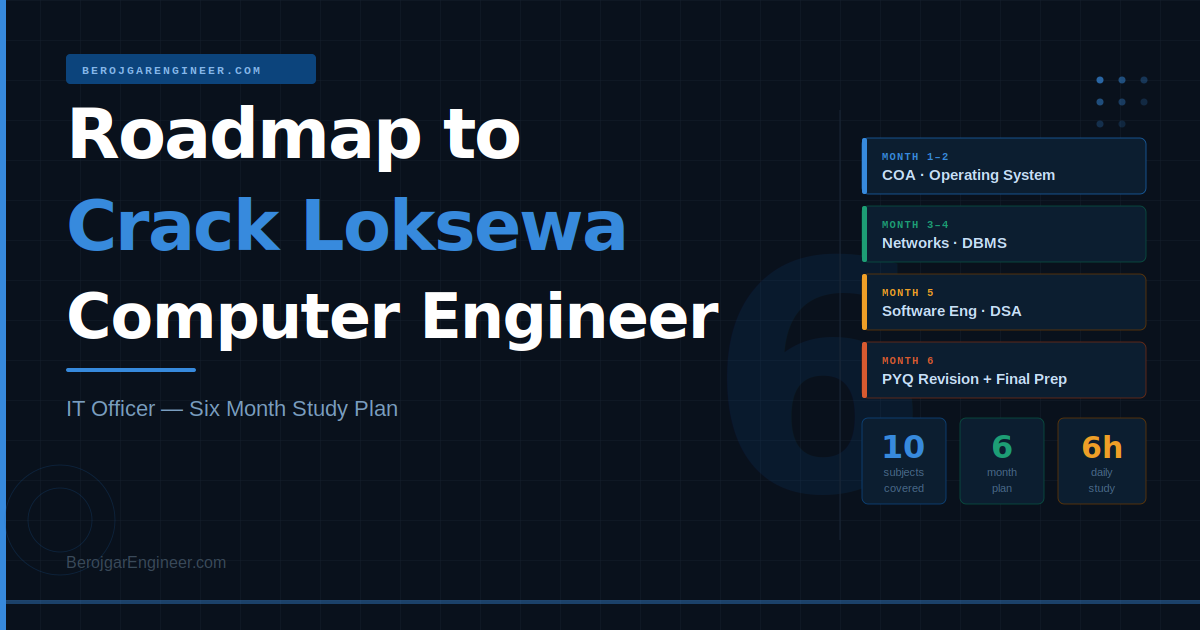
month-1
- COA
- OS
month-2
- CN
- DBMS
month=3
- Software engineering
- DSA
month-4
- programming
- digital logic
month-5
- Cryptography & Network Security
- Emerging Technologies (AI, Big Data, Cloud, IoT)
month-6
- Wrap up studies.
You are done with studies.
best books for first paper
I have researched a lot on this. I have bought many GK books, IQ books, and first paper books of NTC. So, far the only book that I liked is GK King by Ashman Upadhayay.
The book’s link is given below:
GK King(for structured GK study):
https://s.daraz.com.np/s.ZPjHZ?cc
GK Saurav(For old questions solved):
https://s.daraz.com.np/s.ZPjry?cc
If you can get any one of them, get the latter one. It rocks for real. It contains all old questions till 2083 baisakh of GK organized in an easy to digest form. It is organized syllabus unit wise.
Daily study routine
Aim for 6 focused hours of studying each day or 10 hours of “thikthak” focus studies each day. I explicitly kept 10 hours of “thikthak” focus studies because nowadays most of us listen to music on headphones while studying, or study with a laptop, browsing social media and stuff. It is not really focused study. And that is why you will need to spend more time in that case.
What to do in those 6 hours?
From this book, pick the topics and learn them on your own. You could use YouTube, books, whatever to learn. It is totally on you.
Hence, I hope this guide was useful for loksewa aspirants. If you have something to say, contact me: